Is a Self-Emptying Robot Vacuum Worth It in India? (2026 Honest Verdict)
You bought a robot vacuum to stop thinking about cleaning. Then you found yourself emptying its tiny dustbin every single day. Here's the upgrade that actually fixes that.
✍️ PickRyt Editorial📅 March 2026⏱ 8 min read🔍 Opinion + buying guide
Here is the irony at the heart of most robot vacuum ownership stories. You bought the robot to stop thinking about floor cleaning. And for the first week, it was genuinely magical — you'd come home, floors were clean, life was good. Then the notification arrived: "Dustbin full. Please empty."
And you realised: in an Indian home, running a robot daily, you're emptying that little dustbin every single day. Sometimes twice. The robot stopped the sweeping but created a new daily chore — walking to it, opening it, tapping it over the bin, watching a cloud of dust materialise.
The self-emptying dock solves this. Completely. It turns your daily emptying ritual into a monthly one. The question is whether that upgrade — which costs anywhere from ₹0 extra (included on many 2026 models) to ₹15,000 more — is actually worth it for your specific situation. Let's find out.
The Mechanics
⚙️ How Self-Emptying Docks Actually Work
The concept is simpler than it sounds. Your robot vacuum has a small dustbin — typically 150–600 ml — that fills up during a cleaning run. Without auto-empty, you remove and empty this bin manually.
With a self-emptying dock, here's what happens instead:
Not sure which robot vacuum to buy? Get matched in 60 seconds.
Our quiz asks about your home size, floor type and budget — and gives you a personalised recommendation from robot vacuums we've reviewed.
The robot finishes cleaning and returns to its base station.
The dock activates its own powerful suction motor (this is the 5–15 second noise burst you'll hear).
The dock vacuums all the debris from the robot's small dustbin into a much larger sealed bag inside the base — typically 2–3 litres.
The robot's dustbin is now empty and ready for the next run.
You empty or replace the dock's dust bag every 30–60 days.
The result: instead of emptying a small bin every 1–2 days, you handle a larger bag once a month. The frequency of your involvement drops by roughly 15–20x.
First time buying a robot vacuum?
Before deciding on dock type, read our India-first honest take: Is a robot vacuum worth buying in India? (2026) — the complete guide to whether a robot vacuum makes sense for your home before you decide which features to pay for.
Know your options
🗂️ The Three Dock Tiers — What Each Level Actually Does
Not all "auto-empty docks" are equal. In 2026 there are three distinct dock tiers, and the difference between them is significant.
🔌
Basic charging dock
0 days
Charges only. You empty the dustbin manually after every 1–2 runs. No automation of any kind. Found on models under ₹15,000.
♻️
Auto-empty dock
30–60 days
Empties the robot's dustbin into a larger internal bag automatically. Monthly dust bag change. Found on most 2026 models ₹22,000+.
✨
Full-service dock
60–100 days
Auto-empties + washes mop pads with hot water + hot-air dries + refills water tank. Truly hands-free for months. On premium models ₹45,000+.
The jump from "basic charging" to "auto-empty" is the most impactful upgrade in terms of daily convenience. The jump from "auto-empty" to "full-service" adds meaningful value if you use the mopping function — but is less critical for vacuum-only households.
The India angle
🇮🇳 Why Self-Emptying Matters More in Indian Homes
Global reviews of self-emptying docks are written for Western homes where a robot vacuum running every 3 days collects modest amounts of debris. Indian urban homes are a different story — and it makes the auto-empty dock significantly more valuable here.
Indian dust accumulation is extreme by global standards. In cities like Delhi, Mumbai, and Bengaluru, a robot vacuum running daily collects significantly more debris per run than Western benchmarks assume. The robot's small dustbin fills faster — meaning without auto-empty, you're emptying it more frequently than the 1–2 day global average.
Pet owners in India face constant shedding. Indian breeds and imported pets shed year-round in India's climate. A robot collecting pet hair daily fills its bin rapidly. Auto-empty is the difference between a manageable system and an annoying one.
Marble and tile floors don't trap dust. Unlike carpet, hard floors don't hold fine dust — it sits on the surface and gets swept up efficiently by the robot. More debris collected per run = faster bin fill = stronger case for auto-empty.
You're likely scheduling daily runs. The whole point of a robot vacuum in an Indian home is daily autonomous maintenance. Daily runs mean daily bin fills without auto-empty. The upgrade pays for itself in convenience within weeks.
💡 The India calculation: If your robot runs daily and you have an average Indian dusty urban home, you're emptying a manual dustbin 25–30 times per month. With an auto-empty dock, that drops to once per month. That's 24–29 fewer manual interactions per month — the equivalent of recovering about 30–60 minutes of minor but real daily inconvenience.
Your profile
🎯 Who Genuinely Needs It — and Who Can Skip It
✅ Get the auto-empty dock if...
You run the robot daily (most Indian urban homes)
You have pets — daily shedding fills bins fast
You're away from home frequently (travel for work)
You have allergies — sealed dust bags trap allergens better
The budget allows ₹25,000+ for the robot
You want maximum hands-free operation
Your home is 600 sq ft or larger
⚠️ Skip it if...
Your budget is strictly under ₹20,000
You run the robot only 2–3 times per week
You have a small studio apartment (150–250 sq ft)
You don't mind emptying a bin every 2 days
Dock footprint is a concern (auto-empty docks are larger)
You're testing whether robot vacuums suit your home first
⚠️ One thing nobody mentions: Auto-empty docks are bigger. Significantly bigger. The base station is typically 30–40 cm tall and 25–35 cm wide — it needs a dedicated floor spot and a power outlet nearby. In small Indian apartments where every square foot matters, measure your intended dock placement before buying. Some buyers have returned models not because the robot was bad but because the dock didn't fit where they planned.
The money question
💸 The Real Costs of Self-Emptying: Price, Bags, and Maintenance
The price premium for auto-empty varies dramatically by model and tier. Here's how it breaks down in India in 2026:
Scenario
Robot price
Dock included
Dust bag cost
Bags per year
Annual bag cost
Basic only (no auto-empty)
₹12,000–₹18,000
Charging only
None
0
₹0
Auto-empty included
₹22,000–₹35,000
Yes (included)
₹300–₹600 each
6–12
₹1,800–₹7,200
Full-service dock
₹45,000–₹1,20,000
Yes (included)
₹500–₹800 each
6–10
₹3,000–₹8,000
The good news for Indian buyers in 2026: auto-empty docks are now included in most models above ₹22,000 — you no longer pay a separate premium for the feature. The ongoing cost is dust bag replacement, typically ₹300–₹600 per bag, with 6–12 bags per year depending on how dusty your home is and how often you run the robot.
At ₹400/bag and 8 bags per year, that's ₹3,200 annually — less than ₹270/month. For most households this is an entirely acceptable maintenance cost for the convenience delivered.
See all auto-empty models ranked for India
Our complete 2026 buying guide compares every top robot vacuum with auto-empty docks: Best robot vacuum 2026 India — 7 models across every budget, with dock type clearly marked for each.
Best picks
🏆 Best Self-Emptying Robot Vacuums for India 2026
⭐ Best Value Self-Emptying
#1 Best value auto-empty — India sweet spot
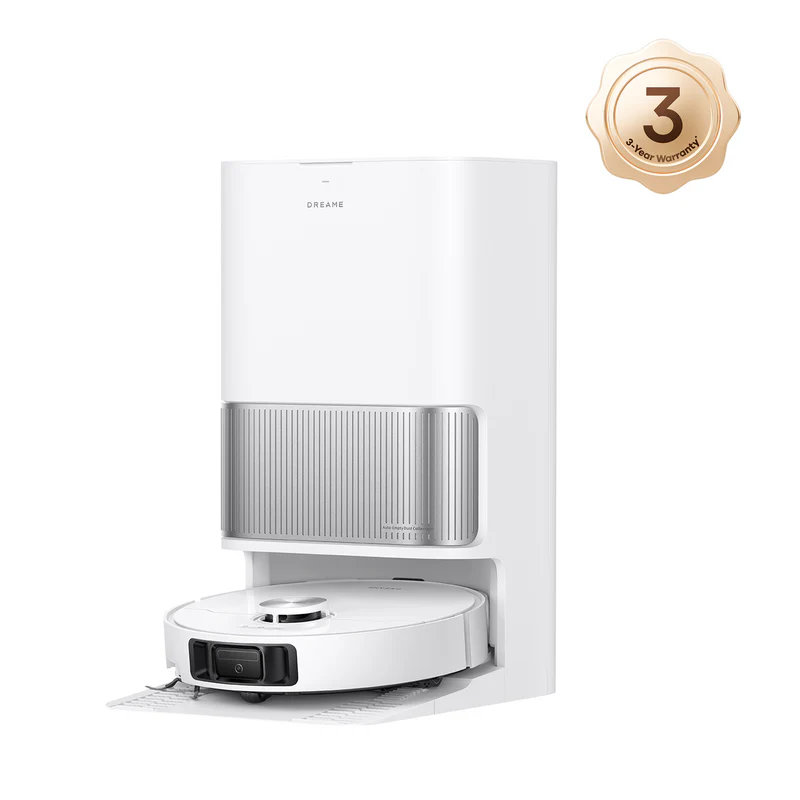
Dreame L40s Ultra
~₹45,000–₹58,000
Auto-empty + hot water mop wash + dryFull-service dock included11,000 Pa suctionAlexa + Google + HomeKit
Not just auto-empty — a full-service dock that washes mop pads with hot water, dries them with heated air, and auto-refills the water tank. All fully automatic. Combined with 11,000 Pa suction and complete smart home integration, this is the best self-emptying robot vacuum for an Indian household that wants true hands-free operation at a justifiable price. The dock handles everything for 45–60 days without requiring your attention.
Best for: Indian homes wanting the complete hands-free experience — auto-empty + mop wash + dry — at the most accessible price for the full dock package.
Auto-empty dock includedFull Roborock app ecosystemAlexa + Google + HomeKitApple Watch compatible
The most accessible way to get the Roborock app ecosystem — considered the best in the robot vacuum category — plus an auto-empty dock under ₹35,000 in India. LiDAR room mapping, room-specific scheduling, HomeKit, and Apple Watch support alongside the auto-empty convenience. The dock handles emptying automatically; you touch the bag about once a month. Best smart home integration with auto-empty in this price range.
Best for: Indian buyers wanting the Roborock app depth and auto-empty convenience at the most accessible budget.
Auto-empty dock includedAlexa + GoogleVacuum + mop comboLiDAR mapping
The most accessible auto-empty robot vacuum in India in 2026. Under ₹28,000, you get LiDAR room mapping, vacuum and mop in one, Alexa and Google integration, and an auto-empty dock that handles daily dustbin emptying automatically. For a first robot vacuum where you want the full hands-free experience without spending flagship money — nothing offers better value in the Indian market right now.
Best for: First-time Indian robot vacuum buyers who want auto-empty convenience at the lowest possible entry price.
Is a self-emptying robot vacuum worth the extra cost in India?
Yes — particularly for daily-running setups in Indian urban homes. In 2026, the good news is that most robot vacuums above ₹22,000 now include auto-empty docks as standard — there is often no extra cost. The ongoing expense is dust bags (₹300–₹600 each, 6–12 per year). For households running the robot daily in India's dusty environment, the convenience of monthly instead of daily emptying makes this a very worthwhile feature.
How does a self-emptying robot vacuum dock work?
When the robot docks after cleaning, the base station runs its own powerful suction motor for 5–15 seconds, vacuuming all debris from the robot's small dustbin into a larger sealed bag inside the dock (typically 2–3 litres). The robot's bin is then clean and ready for the next run. The dock's bag fills over 30–60 cleaning runs and is replaced monthly. Premium full-service docks additionally wash mop pads with hot water, dry them with heated air, and auto-refill the water tank.
How often do you change the dust bag in an auto-empty dock?
Every 30–60 days for most Indian households. In dustier cities like Delhi or areas near construction, expect the lower end (30–40 days). In coastal or cleaner-air cities, bags can last 45–60 days. At an average of 8 bag changes per year and ₹400/bag, the annual cost is around ₹3,200 — less than ₹270/month for the convenience of almost never thinking about dustbin maintenance.
What is the best self-emptying robot vacuum in India in 2026?
The Dreame L40s Ultra (~₹50,000) is the best value self-emptying robot vacuum in India — full-service dock (auto-empty + hot mop wash + dry), 11,000 Pa suction, and complete Alexa/Google/HomeKit integration. For the best entry-level auto-empty option, the Ecovacs Deebot N10 Plus (~₹25,000) includes an auto-empty dock at the lowest India price in 2026. Under ₹35,000, the Roborock Qrevo S offers the best app ecosystem with auto-empty.
Does the auto-empty dock make noise — will it disturb the house?
Yes — the emptying suction runs for 5–15 seconds and is loud (roughly equivalent to a vacuum cleaner burst). Most models empty when the robot docks after finishing a cleaning run. If your cleaning schedule is set for when you're at work (typical: 10 AM–noon weekdays), you'll never hear it. If the robot cleans in the evening, the brief noise burst happens once as it docks — a predictable, short interruption rather than an ongoing noise. Most users stop noticing it within a week.
Are dust bags for auto-empty docks available in India?
Yes — dust bags for all major brands (Dreame, Roborock, Ecovacs, Eufy) are available on Amazon India and Flipkart. Brand-original bags cost ₹300–₹600 each; compatible third-party bags are available for ₹150–₹250. For Dreame and Roborock models, always use original or reputable compatible bags — poor-quality bags can tear inside the dock, which creates a significant cleaning problem.
Short answerYes — for any Indian household running the robot daily. The convenience uplift is real and the cost premium in 2026 is minimal to zero at most price tiers above ₹22,000.
Best value pickDreame L40s Ultra (~₹50K) — full-service dock (empty + mop wash + dry) at the best India price.
Best budget pickEcovacs Deebot N10 Plus (~₹25K) — auto-empty dock at the lowest India entry price in 2026.
Best app + auto-emptyRoborock Qrevo S (~₹32K) — best-in-category Roborock app with auto-empty under ₹35,000.
Skip auto-empty ifYou run the robot less than 3x/week, live in a very small apartment, or are testing the concept for the first time under ₹20,000.
The whole premise of a robot vacuum is automation — removing cleaning tasks from your mental load and your daily to-do list. A robot that runs automatically but needs you to empty its bin every day has only partially delivered on that promise.
The self-emptying dock completes it. One less daily chore. One less notification to act on. Thirty fewer interactions per month. In India's dusty urban environment, where the robot genuinely works hard every single day, that upgrade isn't a luxury — it's the feature that makes the entire system actually hands-free.
Own a robot vacuum with or without auto-empty? Tell us in the comments whether the emptying frequency is actually a daily annoyance in your home — your real experience helps future buyers make better decisions. And if this settled the question for you, share it.